How drones are changing the way roofs are reviewed: A modern approach to maintenance
It used to be that inspecting roofs required climbing to heights and putting ourselves in danger, but modern technology is changing these practices. Drones, which have gained popularity in various walks of life, are now also revolutionizing the way we maintain our homes and buildings. They are making roof inspection not only faster, but also safer, eliminating the risks associated with working at heights. They offer accurate photos and videos that allow a detailed analysis of the condition of roofing. Let’s take a look at how these flying machines are influencing the modern approach to roof maintenance and the benefits they can bring to property owners.
Introduction to drones in roof inspections
Drones have become an indispensable tool in various industries, including construction. Their use in roof inspections brings many benefits that far exceed traditional inspection methods.
History and development of drone technology
The history of drones dates back to the early 20th century, when the first unmanned aerial vehicles were tested for military purposes. The development of this technology over the years has resulted in its availability to civilians. Drones have gained popularity due to advances in component miniaturization and improved GPS functionality.
Today’s drones are equipped with high-quality cameras and sensors that enable accurate inspections. Their ability to capture data from hard-to-reach areas, such as the roofs of buildings, has been revolutionary. As a result, they have become an invaluable tool in the construction industry, offering fast and efficient inspection solutions.
Why drones are ideal for roof inspections
Drones offer unique capabilities that make them an ideal choice for roof inspections. Their mobility allows them to reach hard-to-reach areas, which would require complex equipment with traditional methods.
- Safety: Drones eliminate the need to climb on the roof, reducing the risk of accidents.
- Precision: High-quality cameras provide accurate images, allowing for detailed analysis of the roof’s condition.
- Efficiency: drone inspection is faster, reducing operating costs.
These features make drones extremely effective tools that are revolutionizing traditional approaches to building maintenance.
Advantages of using drones
The use of drones in roof inspections offers many advantages that contribute to a more efficient and safer maintenance process.
Time and cost savings
Drones significantly reduce the time it takes to conduct inspections. Traditional methods require scaffolding and manual inspection, which is time-consuming and costly.
- By using drones, you can save on labor and equipment rental costs.
- Shorter inspection times translate into quicker initiation of potential repair work.
- The efficiency of the process allows for more inspections in less time.
With these advantages, drones are becoming increasingly popular in the construction industry, offering practical and cost-effective solutions.
Safety and precision of measurements
Drones improve safety by eliminating the need to work at height. Operators can remain on the ground, minimizing the risk of accidents related to falls.
- Safe inspections: No climbing on roofs.
- Accurate measurements: advanced sensors provide precise data on the condition of the roof.
- Risk minimization: Reduced risks associated with working at height and adverse weather conditions.
The precision of drone measurements provides accuracy that cannot be achieved by traditional roof inspection methods.
Practical applications of drones
Drones are widely used in roof inspections, offering solutions that are not only fast but also extremely accurate.
Damage inspection and maintenance
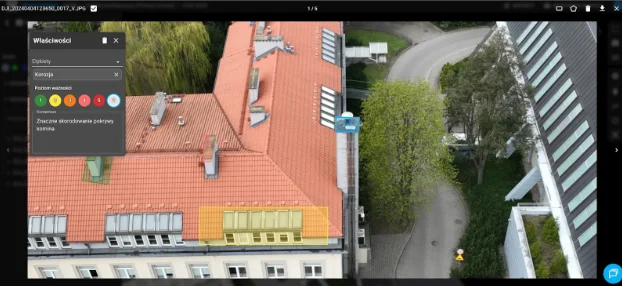
Drones make it possible to detect damage quickly and accurately. Thanks to high-quality cameras, it is possible to identify problems that would be overlooked during traditional inspections.
- Quick Identification: The ability to detect damage immediately.
- Accuracy: Detailed images allow an accurate assessment of the roof’s condition.
- Efficiency: The ability to effectively schedule maintenance work.
With these capabilities, drones are becoming a key tool in roof maintenance and upkeep.
Monitoring the technical condition of roofs
Constant monitoring of the condition of roofs is crucial to the long-term maintenance of buildings. Drones provide the regular and thorough inspections that are essential to keeping roofs in good condition.
- Regular inspections: Ability to monitor technical condition more frequently.
- Comprehensive data: Collecting data to help make maintenance decisions.
- Proactive measures: Early identification of problems allows for quick responses.
With these features, drones support effective building management and counter potential problems.
The future of drone technology in the construction industry
Drone technology continues to evolve, and its future in the construction industry looks promising. New innovations and capabilities could completely change the way we approach building inspection and maintenance.
New opportunities and innovations
Modern drones are equipped with advanced technologies that open up new possibilities in construction. The use of artificial intelligence and data analysis allows for a more comprehensive approach to inspections.
- Smart analytics: Using AI to interpret data collected by drones.
- Automation: The ability to automatically schedule and perform inspections.
- Advanced sensors: Modern drones are equipped with sensors that can collect data beyond standard images.
These innovations can make roof inspections even more accurate and efficient.
Challenges and technological limitations
Despite their many advantages, the use of drones also comes with some challenges. Technological as well as regulatory limitations can affect their use.
- Regulations: Regulations on drone use may limit its use.
- Range and battery: The limited flight time and range of drones presents challenges for longer inspections.
- Weather and weather conditions: Not all drones are designed to operate in harsh weather conditions.
Addressing these issues will be key to the future development of drone technology in the construction industry.
Summary and conclusions
Drones are revolutionizing the way roofs are inspected, offering fast, efficient and safe solutions. It is worth understanding the benefits they can bring and their limitations in order to use them effectively in practice.
Why invest in drones
Investing in drone technology can bring many benefits, especially in the construction industry. These advantages include:
- Reduce inspection and maintenance costs.
- Improved precision and accuracy of collected data.
- Improving worker safety.
With these advantages, drones are becoming an increasingly popular tool in building management.
Key points to remember
Finally, it is worth highlighting the most important aspects of using drones in roof inspections. These are:
- Efficiency: Speed and accuracy of inspection.
- Safety: Eliminate the risk of working at height.
- Innovation: Use of advanced technologies for data analysis.
By understanding these benefits, you can better realize the potential that drones offer in building management and maintenance.

Darmowy E-book
Pomiar objętości materiałów, kruszyw oraz robót ziemnych na placu budowy to jeden z najważniejszych zastosowań dronów. Dlaczego? Bo to czas i pieniądze! Pobierz nasz krótki e-book i dowiedz się jak możesz monetyzować swoją pasję z dronów.
Table of Contents:
Podoba Ci się artykuł? Podziel się nim z innymi!
Podoba Ci się artykuł? Podziel się nim z innymi!
Porady, wiadomości, spostrzeżenia
Powiązane artykuły
Sprawdź nasze artykuły i poznaj najnowsze informacje z branży.